It is really painful to write an obituary for a person whom one has seen growing from a brilliant student to a highly acclaimed scholar. The brutal killing of Papiya along with her maid on the night of December 2 ‘06 was a big shock for her relations, friends, colleagues and students.
I knew Papiya since the beginning of my teaching career. She was one of my first pupils. She was a studious, intelligent and rational student, full of novel ideas. As the Premier of Patna Women’s College, she became known as an excellent debater. She did her post-graduation from the Delhi University and later on joined Hindu College as faculty. She returned back to Patna University in Feb’79 as a teacher of history in Patna Women’s College. It was now another opportunity to see Papiya as a teacher and a colleague.
Her approach to teaching was quite unusual and untraditional. Her punctuality, up-to-date information regarding new arrivals and research and exactitude in giving marks was often discussed among the students. She went on to a Doctoral project under Dr. R. L. Shukla and joined DU again. All appreciated her research-oriented approach. Papiya was a lovable person for those who knew her intimately.
It was Papiya who masterminded the anti-autonomy campaign in Patna Women’s College in 1987-88 and brought the pros and cons of the autonomous college scheme under the 1986 New Education Policy under scrutiny. As it was against the interests of the serving teachers, there was much opposition from teachers. This was our unprecedented united movement in a missionary institution which reached a logical culmination. Consequently, there were many transfers to the post-graduate Department of History, Patna University including myself. Papiya was also transferred in 1992 unceremoniously to the PG. Department from her Alma mater which she used to adore.
Papiya was awarded two fellowships in the 1990s - a Senior fellowship at the Centre for Advance Studies, Simla and the Rockefeller Fellowship, USA. Her field of interests encompassed gender, Indian diaspora, Partition and contemporary affairs. This led her even to make major changes in the syllabus, introducing South Asian History and contemporary India and incorporating topics like Peasant Movements/ Diaspora / Indian Cinema / Media etc.
She was a true teacher and researcher. Her work on Partition and the displacement of Bihari Muslims, their mental agony and present mental and physical state as Diaspora in South Asia was painstaking and thorough. She was about to launch an intellectual debate through the publication of her first book Partition and South Asian Diaspora published from Routledge Publications in India and London simultaneously. This work is part of her trilogy project.
She was a reader of Adhi Zameen, a quarterly magazine dedicated to women’s cause and wrote a research article on Pasmanda Muslim Women and Class Struggle.
Although she never came on the streets to raise the gender issues, she was a gender writer of rare merit. Her enthusiasm and contribution to hold a Refresher Course on “Gender & History” in December 2005 is unforgettable.
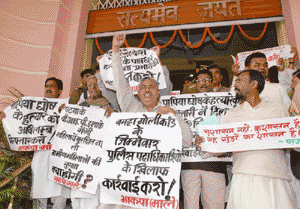
Her gruesome murder saw the widespread anger, anguish and condemnation. The teachers, students and employees all came out, went on one day strike, protested the killing and demanded a CBI Inquiry. Shock prevailed in Department of History, and the Departmental Council expressed its inability to host the 67th Session of the Indian History Congress scheduled in the month of February 2007.
The social scientists and the others belonging to JNU, DU, Jadavpur University, Centre for Advance Studies, Simla all expressed their shock, anger and concern. Scholars of various Universities in Berkeley, London, Chicago, Duke and Rutgers reacted bitterly, sought speedy intervention and criticized the failure of law and order in Bihar.
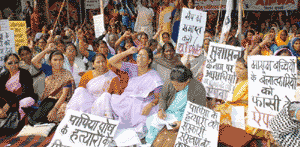
The people of Bihar, once again felt the sense of insecurity and terror, rose to the occasion and expressed their solidarity. All political parties, except the JDU-BJP combine, forced the Bihar CM Nitish Kumar to break his silence in the legislature and give some clear-cut statement. The winter season of both the houses of Bihar legislature remained interrupted for four consecutive days. AIPWA and AISA were spear heading the public movement. On December 12, ‘06 AIPWA staged a massive Dharna toprotest the increasing atrocities on women. Papiya’s killing became a glaring example of continued insecurity to women and other soft targets despite the change of regime in Bihar.
Patna also saw protests like candle light march and the Dharna by the Bengali Association. The result of all these socio-political pressures was the speedy recovery of the stolen articles and the arrest of some of the culprits. Patna police is unable to answer many questions raised even by laypersons. The question whether the crime was an ordinary burglary or with the intention to grab her property or for some other unknown motive does not matter now as Bihar has lost one of its finest scholars.